The Science Behind Our Low Diacetyl Yeast
The Science Behind Our Low Diacetyl Yeast
Why FRESH™ Is Better
Diacetyl control is complicated. Brewers are inventive, they have developed a variety of mitigation strategies. While diacetyl is often manageable using ordinary yeast’s abilities, you can also simply sidestep risks and constraints, surprises, extended timelines and effects on flavor, by using yeast that produces ALDC. With the fine-tuned genetics you get with FRESH™ strains, ALDC functions to prevent diacetyl in all conditions, not just some.
The Science
Diacetyl Forms
Yeast is well able to take up diacetyl and break it down, but if that ɑ-acetolactate-to-diacetyl conversion is not efficient, yeast may not be available to clean it up, as when yeast begins to flocculate towards the end of fermentation.
Speeding Conversion
The diacetyl rest was named sometime around the midcentury, when brewing was becoming increasingly industrialized and temperatures could be precisely controlled. Allowing tank temperature to rise near the end of fermentation speeds up the chemical conversion of ɑ-acetolactate into diacetyl (and boosts yeast metabolism) so that yeast can eliminate diacetyl at a time yeast is still present and active enough to do so. And that does the trick – most of the time.
Enter Challengers (e.g., Hop Creep)
The diacetyl spikes associated with hop creep have gotten more prevalent, especially with modern hopping techniques and increased hop loads; and also more intense with agricultural practices that influence hops’ enzyme content, like lower kilning temperatures.
The ALDC Solution (Spoiler Alert: The Format Matters)
There are two ways to apply ALDC, either as a manufactured ingredient or via yeast that’s enabled to make it as an intracellular enzyme. One works sometimes, the other works always.
Manufactured ALDC
Manufacturers instruct brewers to apply ALDC at knockout, but it's not always effective that way, like during hop creep. To compensate – taking up experimentation themselves – brewers have begun additionally dosing at the time of dry hop, and sometimes even later. The new dose may manage some of the new ɑ-acetolactate that results, but we have seen in experiments how the enzyme may still fail to successfully hold diacetyl below 100 ppb (see “The Data” below).
100 ppb is the level at which most people begin to perceive diacetyl's buttery and slick character, but diacetyl has a negative effect on flavor well before it is recognizable as buttery; even at sub-threshold levels, it blunts the complexity of your hop profile. Decreasing diacetyl far below threshold, then, makes for a cleaner and better tasting beer.
Intracellular ALDC
Where manufactured ALDC can struggle, ALDC that is made by yeast and held within the yeast cell doesn’t. FRESH™ strains (like FRESH™ Chico and new Dry FRESH™ Chico), are enabled to produce ALDC intracellularly, which prevents diacetyl issues completely without exception. For two reasons:
Its functionality is protected inside the cell.
At the same time that the yeast produces ɑ-acetolactate, ALDC is ready to immediately break it down – before it can leak out of the cell.
But don’t just take our word for it, check out how it shows up in the experiment below.
The Data Shows...
After a hop creep-inducing dry hop, FRESH™ Chico is the only solution that reliably, comprehensively protects beer.
The Experiment
Result 1: Both ALDC-assisted Fermentations Achieve Better Results Than Ordinary Yeast During Primary Fermentation
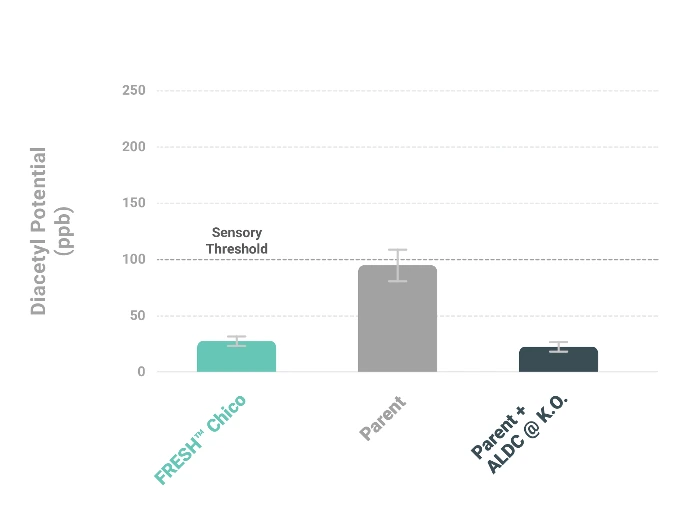
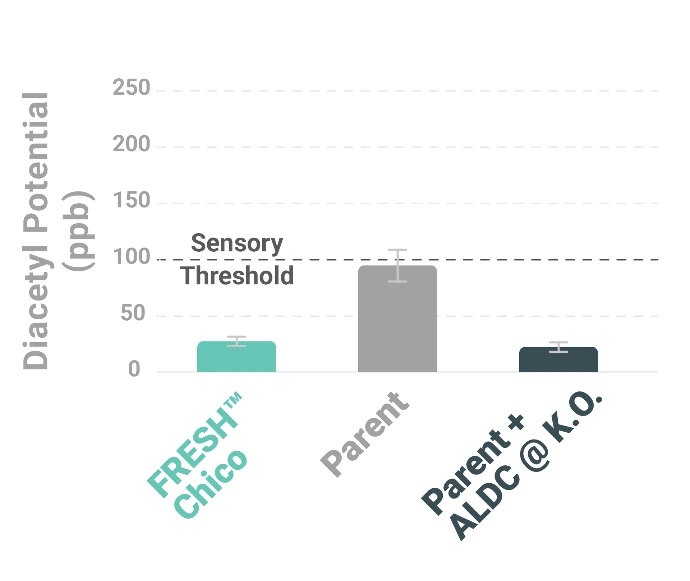
Starting from the left in the chart above, you can see that, under identical conditions:
- Fermentations with FRESH™ Chico (teal bar) and fermentations with the parent ale yeast (light gray bar) both resulted in sub-threshold diacetyl levels (dotted line at 100 ppb). Note that FRESH™ Chico resulted in lower sub-threshold levels of diacetyl than the parent strain.
- FRESH™ Chico (teal bar) and manufactured ALDC (slate bar) both kept diacetyl potential well below threshold. Note: This is true in primary fermentation; but that performance changes in the challenging conditions that are coming next…
Result 2: Only FRESH™ Chico (Intracellular ALDC) Works In Problematic Conditions
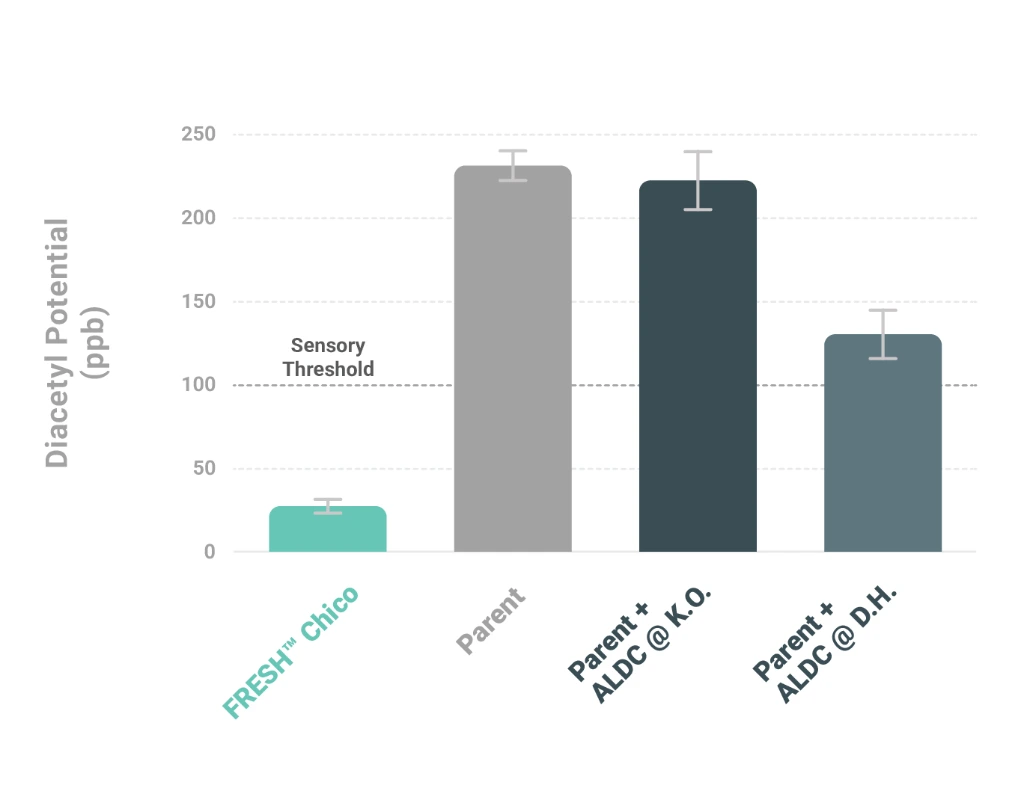
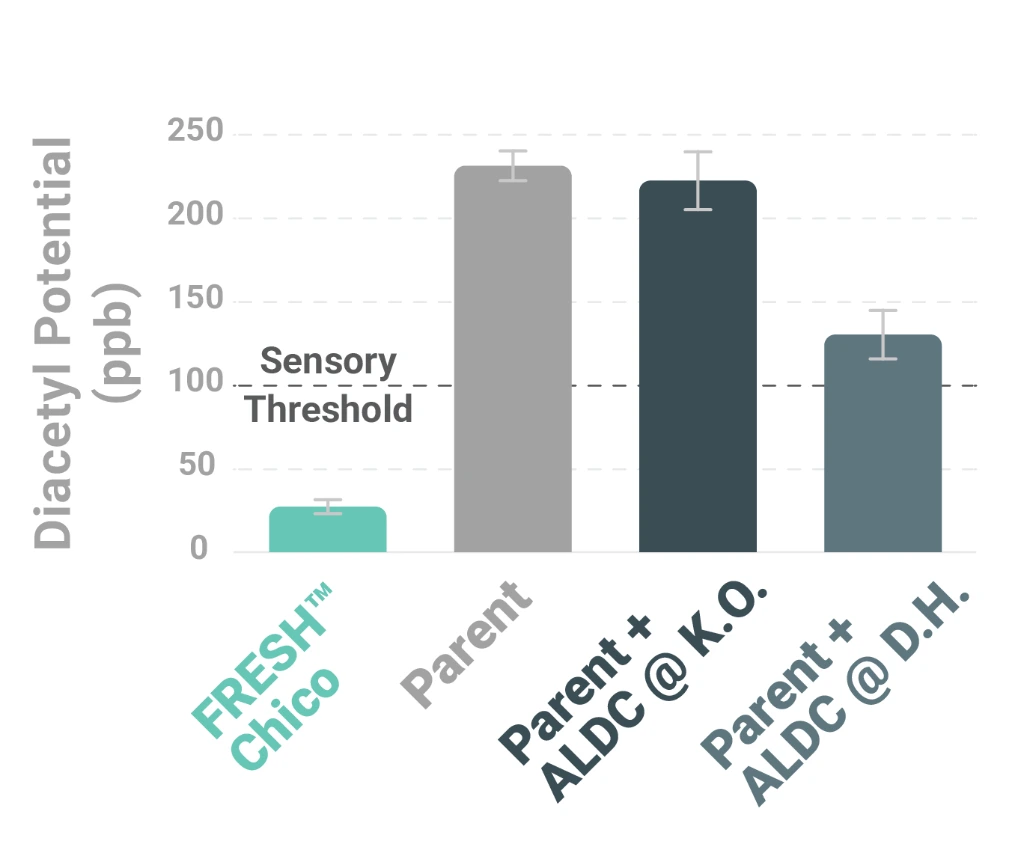
Starting from the left above, you can see that, after an intentionally challenging dry hop:
FRESH™ Chico (teal bar) continued to protect beer thoroughly.
Fermentation with the ordinary parent strain (light gray bar) resulted in skyrocketing diacetyl.
- Manufactured ALDC dosed at knock out (slate bar) was ineffective. Note: This may not come as a surprise — the reason brewers add an extra dose of manufactured ALDC at or after dry hop, is because it doesn't always work well when added at knockout.
- ALDC added at the time of dry hop (blue-gray bar) was still not able to keep diacetyl potential below threshold. Note: This result was surprising. It showed that what brewers are doing to protect beer from a perceived weakness in manufactured ALDC isn’t a perfect solution.
What It Means
That means when FRESH™ Chico delivers ALDC, it never stumbles. First, because the ALDC enzyme is expressed inside the cell where it's always active. Next, because it's expressed in the right amounts, in the right place, at the right time.
Now, any time yeast is producing excess ɑ-acetolactate, it's also producing enough ALDC to intercept it, and all before it ever gets out of the cell. As a result, diacetyl is effectively, reliably, consistently banished to ultra-low levels, leading to a cleaner flavor profile and brighter hop expression, AND categorical protection from anything worse — with no exceptions. Bulletproof.