ALDC-on-a-Switch Perfects Fermentation Performance in Diacetyl-Free Yeast
FRESH™ Chico carries a unique software update and it’s a game-changer. The update is based on a discovery by Berkeley Yeast’s R&D team that relates to ALDC expression and yeast stress. And the update powers both dry and liquid FRESH™ Chico’s pristine fermentation outcomes. Check out the experimental data below—and don’t miss the side-by-side comparison with competitor strains.
Stress? What Stress?
Years of field data hinted at yeast stress within ALDC-producing Chico strains
When using an ALDC-producing “Chico” strain, have you ever had to:
- Add more Biofine® than you’re used to in order to combat haze?
- Acidify to bring down an elevated pH?
- Increase yeast nutrient or aeration to improve viability for repitching?
These are phenomena associated with yeast stress. According to brewers, these stress symptoms are more common when using ALDC-producing yeast than when using the parent Chico, especially after multiple gens.
Even though they didn’t arise in every beer, they occurred frequently enough to make us suspect that intracellular ALDC was adding drag to the system somehow. Research by our R&D team led us to believe we could eliminate this drag altogether.
Balancing Act
We never stopped investigating
It’s essentially a fool’s errand for yeast to leak diacetyl’s precursor, then go clean it up. That’s because diacetyl is entirely non-loadbearing in brewing—it has no known use or purpose in the brewing context aside from being a historically accurate flavor element in a select few beer styles.
α-Acetolactate—the compound that the ALDC enzyme works on—is diacetyl’s precursor, but it also happens to be the precursor for a set of amino acids crucial for yeast growth. That’s why, when employing intracellular ALDC to clean up, balance is key: the enzyme has to clear out sufficient α-acetolactate to stop the overflow that leads to diacetyl, but not so much that it deprives yeast of what it needs for healthy growth.
If that balance is off (too little ALDC or too much) either diacetyl is permitted to form, or yeast’s overall health is compromised. Good design for an ALDC-producing strain requires finding the sweet spot.
Approaching Perfection
Each build brought performance closer to parent Chico
After introducing the first commercially available ALDC-producing yeast strain in 2019, we made our first three updates to the genetic build by connecting the ALDC gene to different genetic controllers, called promoters, each driving ALDC expression to lower and lower levels. Refinement improved the strains’ resilience in challenging brewing conditions, bringing performance closer to parent Chico’s while maintaining the low-diacetyl trait. But, there was a limit to this approach—go too low then you’re back at risk for diacetyl.
Competitor ALDC strains, though they arrived years after ours, use an approach that’s derivative of our earliest strain versions, with ALDC expression further from hitting the sweet spot. That means brewers are still likely to experience issues with strains like ModiGen™D California Ale and West Coast I+ with DKO.
While they're still trying to catch up, we've made another discovery. We found the specific stage of fermentation where ALDC interferes with yeast health and the mechanism behind it. And finding it meant we could fix it—eliminating that drag on the system.
The Switch
A temporary time-out for ALDC
Our R&D team has several methods for eavesdropping on yeast’s cellular processes, one of which is RNA sequencing. Studying a strain’s genome—its DNA—reveals its potential; studying its RNA, the working copies the cell makes from DNA, reveals which parts of that potential the cell is putting to use at a given moment. Yeast has protocols for scarcity. When its metabolism runs low on something it needs, the cell shifts its resources from growth toward synthesizing the missing building blocks. Using RNA sequencing, we caught that shift happening.
We looked at RNA levels in what was then our most recent version of FRESH™ Chico, across both its full genome and throughout the entirety of fermentation—and compared what we found to the parent Chico strain. We discovered a significant difference in one small subset of genes, early in fermentation, during yeast’s growth phase: elevated RNA levels across the genes directly related to synthesizing α-acetolactate-dependent amino acids. The cell appeared to be compensating for an α-acetolactate shortage by diverting growth to synthesis—a solid indication that intracellular ALDC was depleting an amount of α-acetolactate that the yeast needed, and not just excess.
We hypothesized that if ALDC was held away from the α-acetolactate pool during the growth phase and then allowed to work freely afterwards (i.e. put in a temporary time-out), the yeast’s performance would be restored to that of the parent strain. To test the hypothesis, we whipped up a conditional genetic switch designed to keep ALDC expression “off” during early fermentation and to turn it “on” after the initial growth phase (patent pending).
And it worked.
The Data
The research
1. Elevated Gene Expression in Early Fermentation
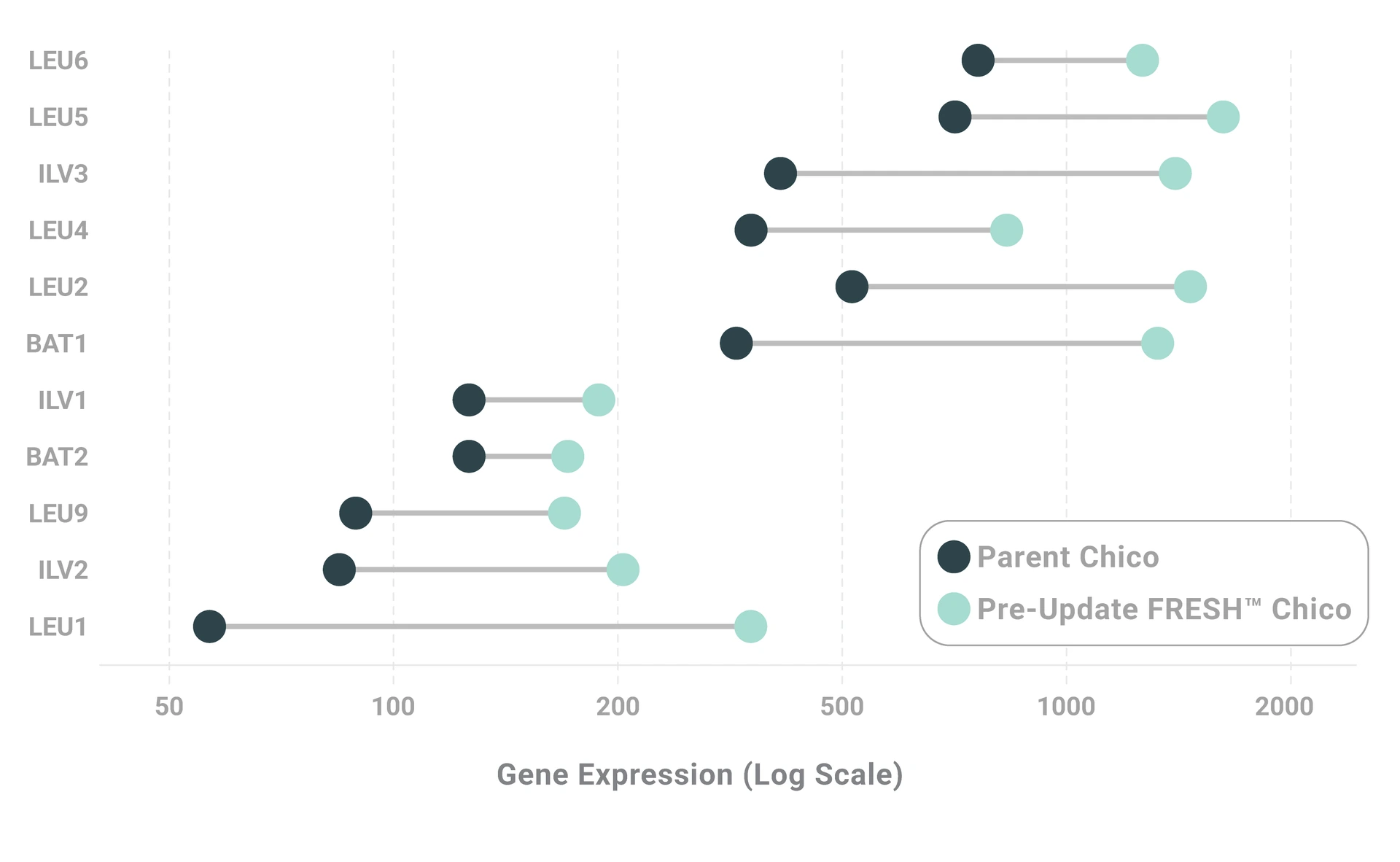
Parent Chico vs. Pre-Update FRESH™ Chico
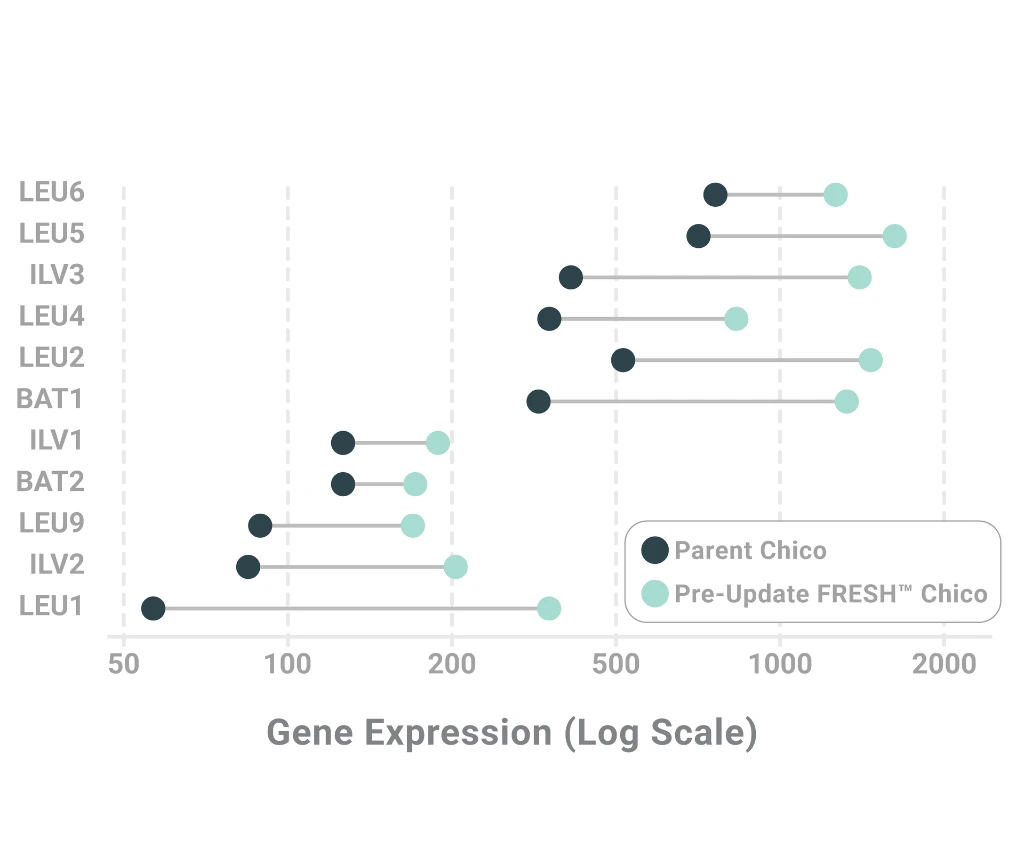
The Stress Signature. The distance between the slate and light teal colored points shows that the pre-update version of FRESH™ Chico (teal) is expressing the genes in the α-acetolactate-dependent amino acid biosynthesis pathway differently compared to parent Chico (slate).
This is called a dumbbell plot. It shows the level of expression for the group of 11 genes in the α-acetolactate-dependent amino acid biosynthesis pathway early in fermentation. Each dumbbell reflects the difference in expression for one gene between two strains. The darker colored point (slate) is parent Chico, our baseline. The lighter colored one (teal) is pre-update FRESH™ Chico. The farther right the teal point sits from the slate point, the larger the relative increase in gene expression. Notice that for every gene, the teal point falls to the right of the slate point, meaning that for all 11 genes, pre-update FRESH™ Chico is turning up expression. This indicates that it is compensating for an apparent lack of resources by upregulating these genes, which is a clear molecular signature of amino acid starvation. The ALDC-producing strain is reacting to too little α-acetolactate inside the cell, and shifting resources accordingly.
2. Flipping the Switch
Updated FRESH™ Chico with the Switch
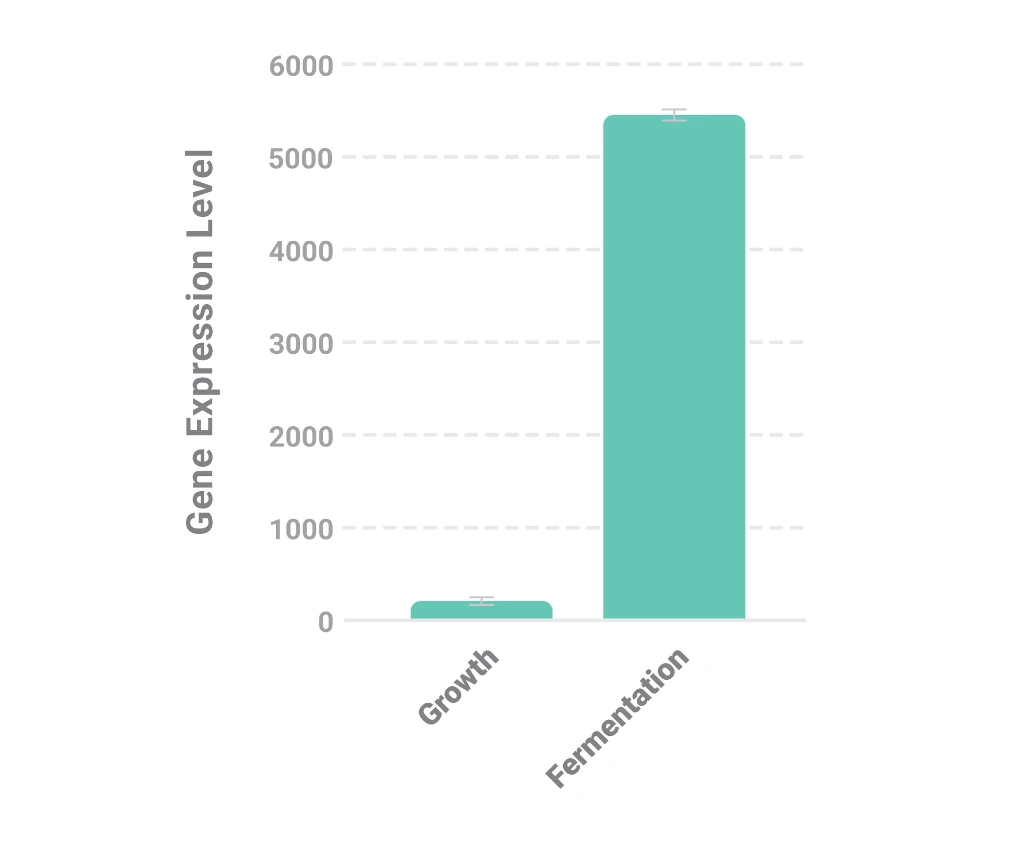
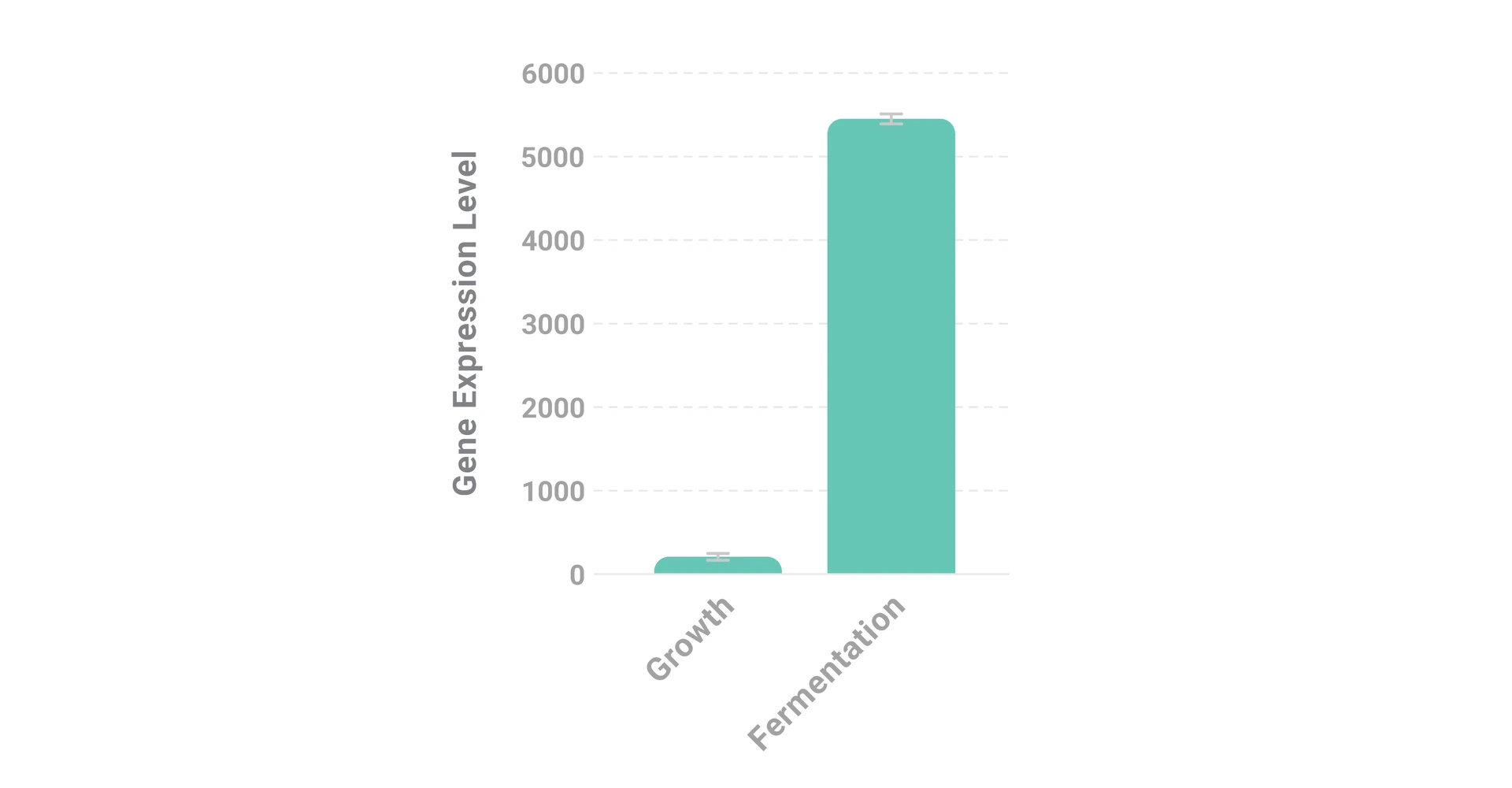
The Switch. In FRESH™ Chico with the switch, ALDC expression levels are “off” during the growth phase, and “on” for the remainder of fermentation (ALDC is cranking going into dry hop, so diacetyl stays low).
We installed an off/on switch for ALDC in FRESH™ Chico, then we brewed with it. We measured ALDC expression during the growth phase and again later in fermentation. The two bars in the chart above show the relative expression of the ALDC gene: during the growth phase, ALDC expression was effectively “off”. Later in fermentation, ALDC expression was cranking, as expected. We had confirmed that both the “off” and the “on” of the switch were working properly.
But what would that mean for the α-acetolactate-dependent amino acid pathway?
3. Restored Gene Expression
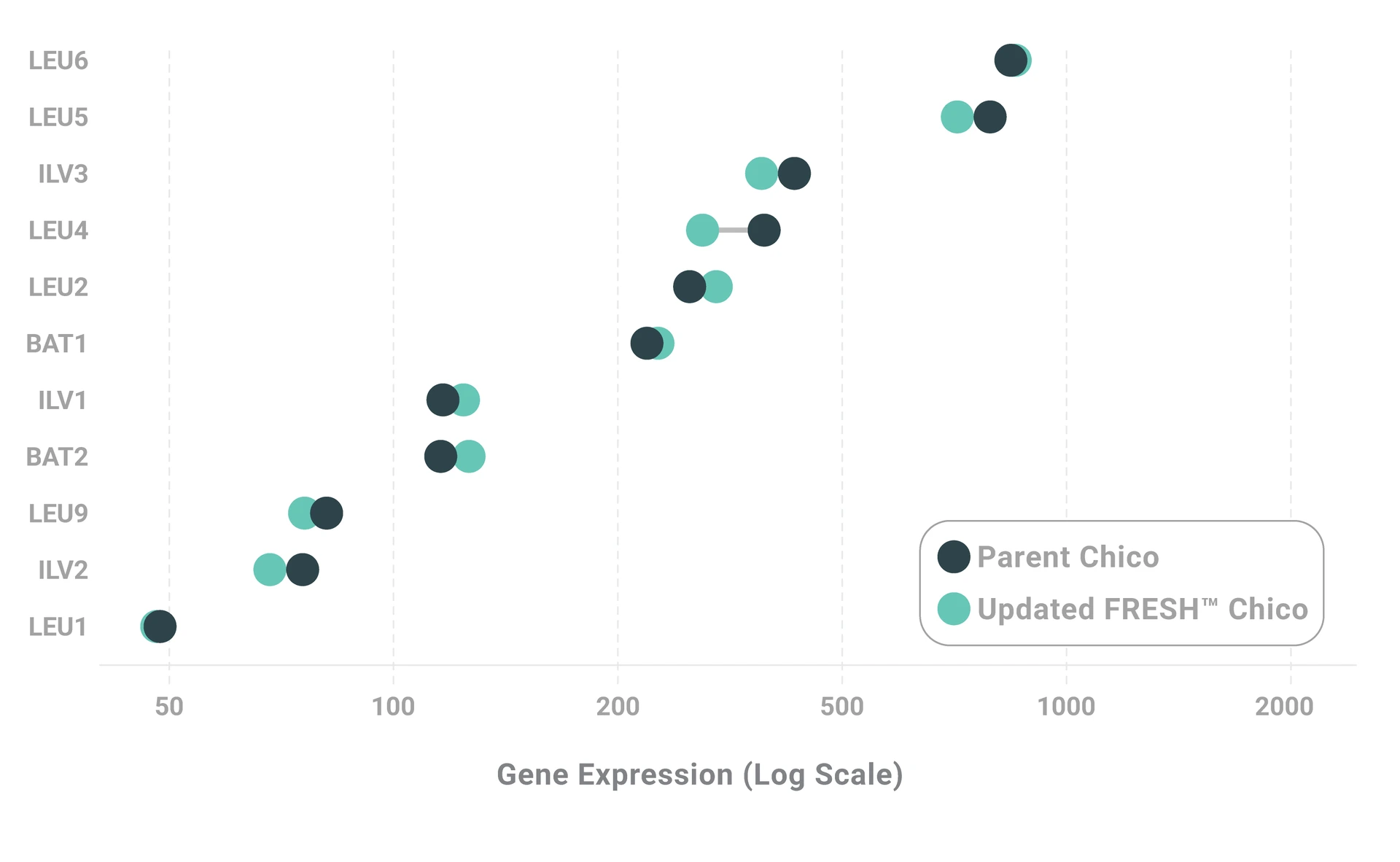
Parent Chico vs. Updated FRESH™ Chico with the Switch
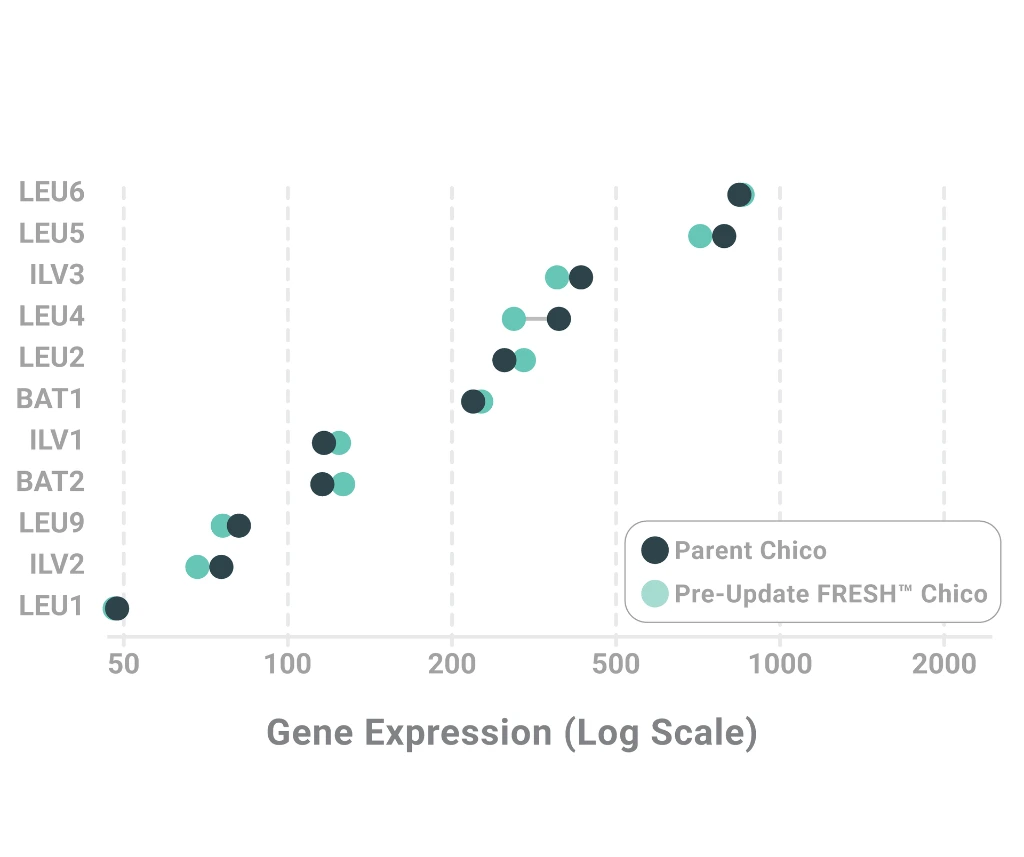
Stress Relief. With the genetic switch operational, gene expression in the α-acetolactate-dependent amino acid biosynthesis pathway is now equivalent to parent Chico.
Let’s go back to those 11 genes in the α-acetolactate-dependent amino acid pathway to see how the conditional switch affected RNA levels. Did it successfully clear signs of amino acid starvation?
Heck yeah it did.
In FRESH™ Chico, now with the ALDC switch wired in, gene expression was back at baseline.
The Result
Comparing growth
Updated FRESH™ Chico vs. Other ALDC Strains
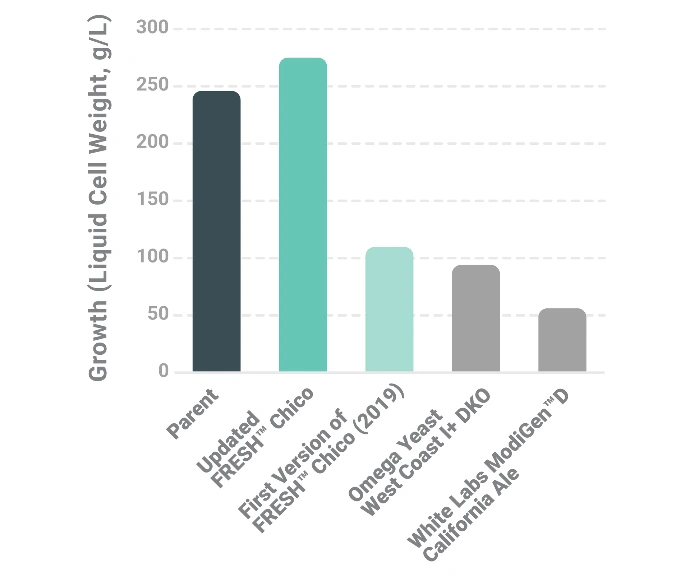
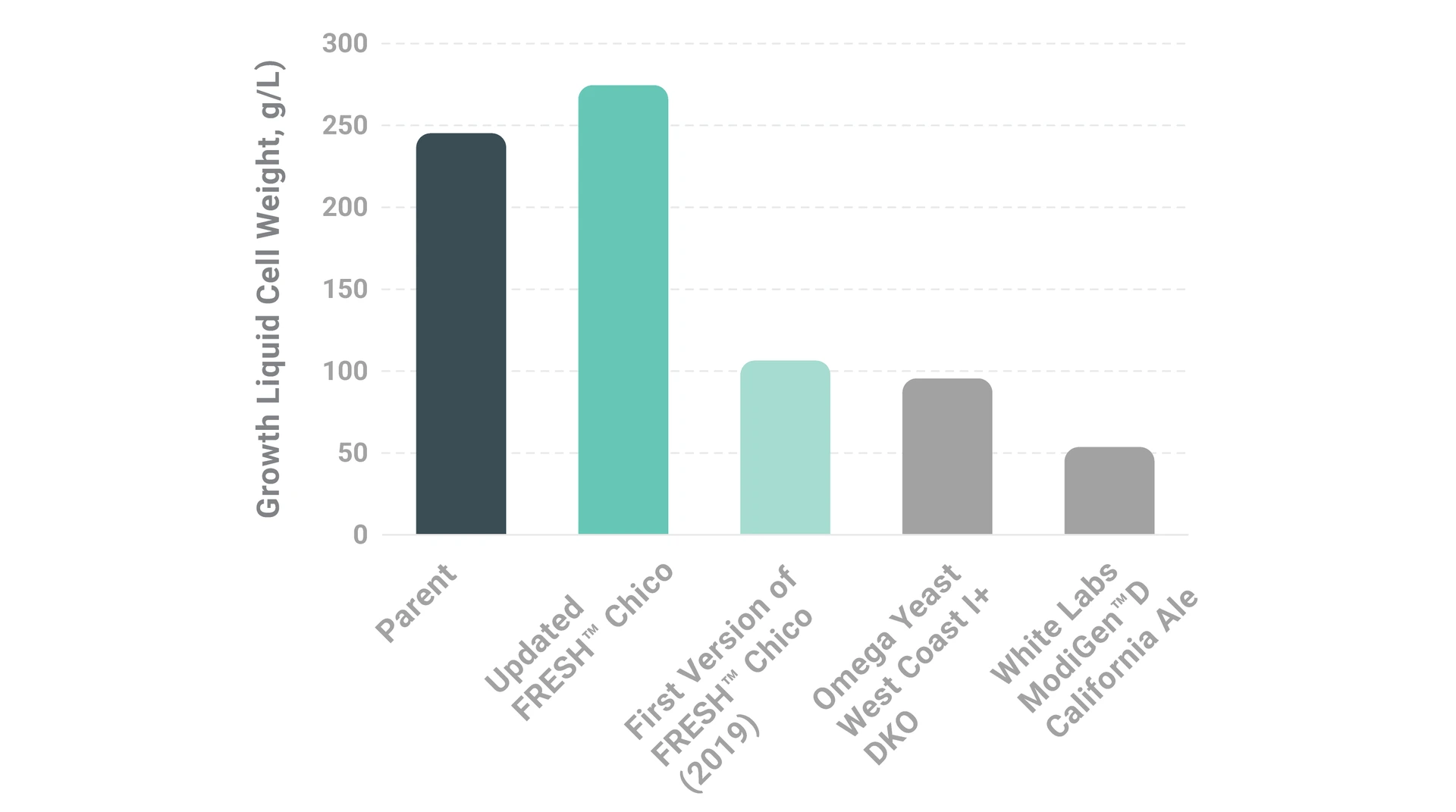
Growth, a Proxy for Yeast Health. Pre-update FRESH™ Chico and competitor strains don’t grow well. The updated FRESH™ Chico—just like parent Chico—is healthy, and accumulates biomass at the expected levels.
Remember the signs of stress brewers were seeing, the ones we flagged at the beginning? They popped up most frequently after re-pitching across multiple gens. During a single beer fermentation, yeast cells double 2–3 times. If ALDC is affecting the yeast’s potential to grow, the issues described above might not be caught after a single fermentation; sometimes multiple growth cycles are needed before you can see that the yeast is stressed—and only then do observable beer defects, like unwanted haze, pop up. Think about a group of people going for a walk versus running a marathon. On the walk, differences in fitness between members of the group aren’t likely to show. During a marathon, however, a spread will become obvious.
We wanted to test the updated FRESH™ Chico and other ALDC strains in a scenario where differences in performance would be clearly observable. So, we set up an experiment where we kept the yeast in growth phase for an extended amount of time, pushing the yeast to double many more times than it would during a single beer fermentation. You can think of it like a forced aging experiment, except instead of accelerating beer aging, we are accelerating what happens when yeast is repitched multiple times.
We conducted this experiment by growing each strain in a bioreactor with constant aeration and nutrient feeding, keeping the yeast in the aerobic growth phase so the cells would replicate over and over again. This isolated the stage where ALDC had been interfering. Then we tracked cell growth as a readout for yeast health.
Here’s what we observed:
- Parent Chico grew well and accumulated a large amount of biomass, as anticipated. This is our baseline for how a healthy, resilient yeast strain performs (see slate bar above).
- The pre-update FRESH™ Chico and the competitor strains could not maintain an exponential growth phase for long. They all bonked early, finishing with roughly 40% of the biomass that parent Chico had (see how the light teal, and the light gray bars compare to the slate bar above).
We had effectively recreated “the marathon.” And we were seeing the health defect that brewers had observed. These strains were producing too much ALDC during the growth phase, which was negatively impacting their health to such an extent that they didn’t have the metabolic resources or robustness to support several doublings in our assay. - The updated FRESH™ Chico (carrying the off/on switch) kept pace with parent Chico. It grew extremely well, indicating that we had effectively eliminated all drag on the system (see the teal bar above compared to all of the bars to the right of it). Since ALDC was “off” during the growth phase, the yeast was able to grow just like parent Chico.
We can confirm that the improvement carries over to actual beer fermentations at scale: Brewers have reported that FRESH™ Chico, in liquid or dry format, keeps diacetyl ultra-low and is highly performant throughout multiple gens, exactly as you would expect.
ALDC-on-a-Switch Perfects Fermentation Performance in Diacetyl-Free Yeast
FRESH™ Chico carries a unique software update and it’s a game-changer. The update is based on a discovery by Berkeley Yeast’s R&D team that relates to ALDC expression and yeast stress. And the update powers both dry and liquid FRESH™ Chico’s pristine fermentation outcomes. Check out the experimental data below—and don’t miss the side-by-side comparison with competitor strains.
Stress? What Stress?
Years of field data hinted at yeast stress within ALDC-producing Chico strains
When using an ALDC-producing “Chico” strain, have you ever had to:
- Add more Biofine® than you’re used to in order to combat haze?
- Acidify to bring down an elevated pH?
- Increase yeast nutrient or aeration to improve viability for repitching?
These are phenomena associated with yeast stress. According to brewers, these stress symptoms are more common when using ALDC-producing yeast than when using the parent Chico, especially after multiple gens.
Even though they didn’t arise in every beer, they occurred frequently enough to make us suspect that intracellular ALDC was adding drag to the system somehow. Research by our R&D team led us to believe we could eliminate this drag altogether.
Balancing Act
We never stopped investigating
It’s essentially a fool’s errand for yeast to leak diacetyl’s precursor, then go clean it up. That’s because diacetyl is entirely non-loadbearing in brewing—it has no known use or purpose in the brewing context aside from being a historically accurate flavor element in a select few beer styles.
α-Acetolactate—the compound that the ALDC enzyme works on—is diacetyl’s precursor, but it also happens to be the precursor for a set of amino acids crucial for yeast growth. That’s why, when employing intracellular ALDC to clean up, balance is key: the enzyme has to clear out sufficient α-acetolactate to stop the overflow that leads to diacetyl, but not so much that it deprives yeast of what it needs for healthy growth.
If that balance is off (too little ALDC or too much) either diacetyl is permitted to form, or yeast’s overall health is compromised. Good design for an ALDC-producing strain requires finding the sweet spot.
Approaching Perfection
Each build brought performance closer to parent Chico
After introducing the first commercially available ALDC-producing yeast strain in 2019, we made our first three updates to the genetic build by connecting the ALDC gene to different genetic controllers, called promoters, each driving ALDC expression to lower and lower levels. Refinement improved the strains’ resilience in challenging brewing conditions, bringing performance closer to parent Chico’s while maintaining the low-diacetyl trait. But, there was a limit to this approach—go too low then you’re back at risk for diacetyl.
Competitor ALDC strains, though they arrived years after ours, use an approach that’s derivative of our earliest strain versions, with ALDC expression further from hitting the sweet spot. That means brewers are still likely to experience issues with strains like ModiGen™D California Ale and West Coast I+ with DKO.
While they're still trying to catch up, we've made another discovery. We found the specific stage of fermentation where ALDC interferes with yeast health and the mechanism behind it. And finding it meant we could fix it—eliminating that drag on the system.
The Switch
A temporary time-out for ALDC
Our R&D team has several methods for eavesdropping on yeast’s cellular processes, one of which is RNA sequencing. Studying a strain’s genome—its DNA—reveals its potential; studying its RNA, the working copies the cell makes from DNA, reveals which parts of that potential the cell is putting to use at a given moment. Yeast has protocols for scarcity. When its metabolism runs low on something it needs, the cell shifts its resources from growth toward synthesizing the missing building blocks. Using RNA sequencing, we caught that shift happening.
We looked at RNA levels in what was then our most recent version of FRESH™ Chico, across both its full genome and throughout the entirety of fermentation—and compared what we found to the parent Chico strain. We discovered a significant difference in one small subset of genes, early in fermentation, during yeast’s growth phase: elevated RNA levels across the genes directly related to synthesizing α-acetolactate-dependent amino acids. The cell appeared to be compensating for an α-acetolactate shortage by diverting growth to synthesis—a solid indication that intracellular ALDC was depleting an amount of α-acetolactate that the yeast needed, and not just excess.
We hypothesized that if ALDC was held away from the α-acetolactate pool during the growth phase and then allowed to work freely afterwards (i.e. put in a temporary time-out), the yeast’s performance would be restored to that of the parent strain. To test the hypothesis, we whipped up a conditional genetic switch designed to keep ALDC expression “off” during early fermentation and to turn it “on” after the initial growth phase (patent pending).
And it worked.
The Data
The research
1. Elevated Gene Expression in Early Fermentation
Parent Chico vs. Pre-Update FRESH™ Chico
The Stress Signature. The distance between the slate and light teal colored points shows that the pre-update version of FRESH™ Chico (teal) is expressing the genes in the α-acetolactate-dependent amino acid biosynthesis pathway differently compared to parent Chico (slate).
This is called a dumbbell plot. It shows the level of expression for the group of 11 genes in the α-acetolactate-dependent amino acid biosynthesis pathway early in fermentation. Each dumbbell reflects the difference in expression for one gene between two strains. The darker colored point (slate) is parent Chico, our baseline. The lighter colored one (teal) is pre-update FRESH™ Chico. The farther right the teal point sits from the slate point, the larger the relative increase in gene expression. Notice that for every gene, the teal point falls to the right of the slate point, meaning that for all 11 genes, pre-update FRESH™ Chico is turning up expression. This indicates that it is compensating for an apparent lack of resources by upregulating these genes, which is a clear molecular signature of amino acid starvation. The ALDC-producing strain is reacting to too little α-acetolactate inside the cell, and shifting resources accordingly.
2. Flipping the Switch
Updated FRESH™ Chico with the Switch
The Switch. In FRESH™ Chico with the switch, ALDC expression levels are “off” during the growth phase, and “on” for the remainder of fermentation (ALDC is cranking going into dry hop, so diacetyl stays low).
We installed an off/on switch for ALDC in FRESH™ Chico, then we brewed with it. We measured ALDC expression during the growth phase and again later in fermentation. The two bars in the chart above show the relative expression of the ALDC gene: during the growth phase, ALDC expression was effectively “off”. Later in fermentation, ALDC expression was cranking, as expected. We had confirmed that both the “off” and the “on” of the switch were working properly.
But what would that mean for the α-acetolactate-dependent amino acid pathway?
3. Restored Gene Expression
Parent Chico vs. Updated FRESH™ Chico with the Switch
Stress Relief. With the genetic switch operational, gene expression in the α-acetolactate-dependent amino acid biosynthesis pathway is now equivalent to parent Chico.
Let’s go back to those 11 genes in the α-acetolactate-dependent amino acid pathway to see how the conditional switch affected RNA levels. Did it successfully clear signs of amino acid starvation?
Heck yeah it did.
In FRESH™ Chico, now with the ALDC switch wired in, gene expression was back at baseline.
The Result
Comparing growth
Updated FRESH™ Chico vs. Other ALDC Strains
Growth, a Proxy for Yeast Health. Pre-update FRESH™ Chico and competitor strains don’t grow well. The updated FRESH™ Chico—just like parent Chico—is healthy, and accumulates biomass at the expected levels.
Remember the signs of stress brewers were seeing, the ones we flagged at the beginning? They popped up most frequently after re-pitching across multiple gens. During a single beer fermentation, yeast cells double 2–3 times. If ALDC is affecting the yeast’s potential to grow, the issues described above might not be caught after a single fermentation; sometimes multiple growth cycles are needed before you can see that the yeast is stressed—and only then do observable beer defects, like unwanted haze, pop up. Think about a group of people going for a walk versus running a marathon. On the walk, differences in fitness between members of the group aren’t likely to show. During a marathon, however, a spread will become obvious.
We wanted to test the updated FRESH™ Chico and other ALDC strains in a scenario where differences in performance would be clearly observable. So, we set up an experiment where we kept the yeast in growth phase for an extended amount of time, pushing the yeast to double many more times than it would during a single beer fermentation. You can think of it like a forced aging experiment, except instead of accelerating beer aging, we are accelerating what happens when yeast is repitched multiple times.
We conducted this experiment by growing each strain in a bioreactor with constant aeration and nutrient feeding, keeping the yeast in the aerobic growth phase so the cells would replicate over and over again. This isolated the stage where ALDC had been interfering. Then we tracked cell growth as a readout for yeast health.
Here’s what we observed:
- Parent Chico grew well and accumulated a large amount of biomass, as anticipated. This is our baseline for how a healthy, resilient yeast strain performs (see slate bar above).
- The pre-update FRESH™ Chico and the competitor strains could not maintain an exponential growth phase for long. They all bonked early, finishing with roughly 40% of the biomass that parent Chico had (see how the light teal, and the light gray bars compare to the slate bar above).
We had effectively recreated “the marathon.” And we were seeing the health defect that brewers had observed. These strains were producing too much ALDC during the growth phase, which was negatively impacting their health to such an extent that they didn’t have the metabolic resources or robustness to support several doublings in our assay. - The updated FRESH™ Chico (carrying the off/on switch) kept pace with parent Chico. It grew extremely well, indicating that we had effectively eliminated all drag on the system (see the teal bar above compared to all of the bars to the right of it). Since ALDC was “off” during the growth phase, the yeast was able to grow just like parent Chico.
We can confirm that the improvement carries over to actual beer fermentations at scale: Brewers have reported that FRESH™ Chico, in liquid or dry format, keeps diacetyl ultra-low and is highly performant throughout multiple gens, exactly as you would expect.